
Turning 50
On illness, love, impermanence, and hope that doesn’t depend on outcomes

I love the dark hours of my being.
My mind deepens into them.
There I can find, as in old letters, the days of my life, already lived, and held like a legend, and understood.
Then the knowing comes: I can open to another life that’s wide and timeless.
So I am sometimes like a tree rustling over a grave and making real the dream of the one its living roots embrace:
a dream once lost among sorrows and songs.
- Rainer Maria Rilke
Preamble
I turn 50 this week. It’s been an especially challenging birthday. If it weren’t for the muscular dystrophy, I believe it would be something purely to celebrate.
I’m proud of the family Deb and I have created together. I’m proud of our relationship. Everything we’ve been through and continue to navigate. How much we’ve grown together. All the storms we’ve weathered. How many versions of ourselves and our relationship have emerged over time. Many couples stay together. That in and of itself is a feat. But it’s rare that relationships not just permit the space to change, but that they’re greenhouses for it.
I remember the first year we were together in London on Constantine Road. We were 26 and in la-la land. I was doing my PhD and a clinical training. My friend dropped me off after class on Wednesdays. She was ten years older, married with young kids. We were parked outside my house. She asked me what our plans were for the rest of the week. I said we were taking the train to Paris for the weekend. She saw the stars in my eyes and smiled and shook her head and told me to enjoy it and that we had no clue. We didn’t have a clue. We had no idea the road we were about to travel. I know what we’ve been through would have broken most couples. 23 years later. I’m so proud of us.
I’m proud of how I show up as a dad to my kids. The ease they both have sharing with me, trusting me to guide them. Being a dad is one of the few things that makes perfect sense to me. I never question the point. I feel like it’s what I was born for. I’m so devoted to my children. They know that. They’ll always know it and carry it with them long past when I’m gone.
I’m proud of my work as a therapist. It’s exhausting at times, but I can’t imagine doing anything else. Getting up to work to help people. Having accompanied some of them for almost 20 years. Such a privilege. I love the people I work with. I get to work from home in a way that allows me to do what I do given all of my limitations and that allows me to support my family along with my wife. I love that we share that role together.
I’m proud of my friendships. I have the most amazing group of friends. Most live elsewhere. We don’t talk on the phone every day or see each other all the time, but we do what we have to do. I don’t even think of them as distinct from my family. My friends are my family.
I’m proud of my values. My resilience. My mind. My heart. My honesty and perspective. I’m proud that at 50, I’m intimately connected with impermanence. I can envision my deathbed. I don’t know when it will be, but I know the things I need to do to die peacefully. I know that nothing else will matter at that point other than love. How I’ve loved and how I’ve been loved. Nothing else really matters now, but we have to pay the bills and there are a lot more distractions than there will be when I’m drawing my final breaths.
I’m proud of how I’ve navigated living with this beast of a disease. It has taken so much from me and yet it continues to be my biggest teacher. I wouldn’t be the man I am without it. Everything I love about myself is inextricably bound to it. I’ve followed it deeper and deeper to the edges. It has constricted my possibilities and expanded my consciousness. The DUX4 gene has been both the light leading the way and the darkness itself that’s illuminated.
Joseph Goldstein said: “Don’t waste your suffering. When we’re suffering, there’s something to learn.” I have not wasted mine. I feel like my forties have been filled with suffering and that I have never been clearer about who my greatest teacher is.
The Sadness
There’s so much I’m proud of and grateful for. And I feel deep sadness. I feel sadness for all the loss I’ve experienced. The loss of ability. The loss of possibility. The loneliness and alienation. The pain. I feel sadness that I cannot go for a walk around the block, take a drive, play guitar, or know what it’s like to live in a body that cooperates. To not have to concentrate when I get up from a chair, take a shower, take a step.
I miss all the things I can’t do with my wife and with my kids, as simple as lying down in bed with my daughter when she goes to sleep. I’m sad that we have to pay more and more for increasing amounts of care, that most of our expenses are medical and health related.
I’m sad that I never spoke about all of this as a child and that, although I always felt loved, no one was able to hold it with me. Everything I witnessed happening to my mother that I knew was going to happen to me. The unprocessed fear and sadness that went unspoken and unseen. I can see that child now in ways I never could before, with love and compassion and a desire to embrace and accompany him. I’m sad that it has taken years to get to this point where I can feel my sadness and hold it so that it doesn’t curdle into undigested depression. I’m sad and I’m grateful for that.
I’m sad that my mother isn’t here to see me turn 50.
Postamble
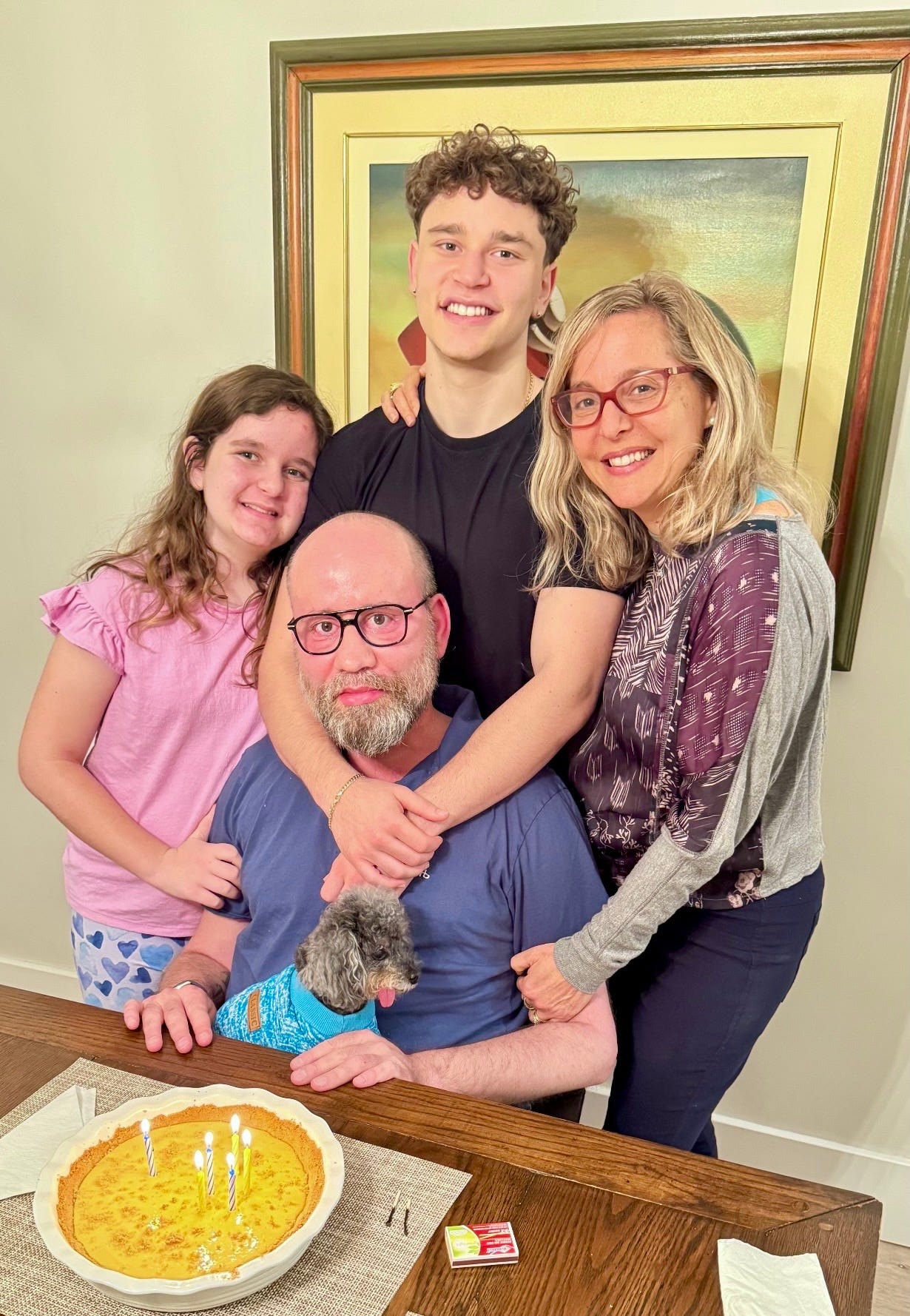
I’m writing this part the day after my birthday. The gestation period was filled with existential angst, pain and sadness. It appears that when the day arrived, someone slipped me an epidural. I still experienced the contractions, but I felt peaceful, present and grateful. I started the day in homage to my late grandfather. I woke up at 7am, exercised for 65 minutes and worked. I finished an hour earlier than normal, meditated and went for oysters and shrimp cocktail with Deb. I received so many text messages and calls from loved ones. The sun was setting as we slurped down the last of 18 briny blue points and Deb put a FedEx box on the table in front of me. I opened the box to a spiral bound book with a picture of us and the kids on the cover. Inside the book, a collection of letters from my closest friends and family. I spoke to a friend this morning and described it as a love bomb. She asked if it was a love bomb or a love balm. It was both. An explosion of love and the salve to heal the exposed existential wounds that have haunted me in the time leading up to my birthday.
I told my loved ones that it is the most meaningful gift I’ve ever received. Reading them made me think about the Hasidic teaching to place words on our hearts, not in them, because our hearts are closed, so the words wait on top until the heart breaks and they fall in. My heart is broken and their words filled it.
What I’ve Learned
Bertrand Russell said: “To be without some of the things you want is an indispensable part of happiness.” As much loss as I have experienced, I’m not one of those people whose life is so riddled with trauma that new life can no longer take hold. I am not abundance and I am not loss. Abundance and loss flow through me and I cannot be reduced to anything unless I allow the mind to do so.
Stephen Levine taught that sometimes we’ve done so little exploration of ourselves that we only feel alive when we feel pain. We get addicted to it. We’re so used to paying so little attention that something like grief demands our attention and makes us feel more alive.
I’ve learned that I can’t be happy until I learn how to be unhappy. Levine said fear, anger, doubt—all of it is grief. All of it is response to loss. Loss of connection. Loss of safety. The difference between pain and suffering is how we relate to the pain. The more we react, looking for safe territory, the more we suffer. But in pain, there’s the possibility of healing.
This is what Frank Ostaseski means when he talks about learning to stay present with uncertainty rather than seeking security. Learning how to work with fear instead of running from it. Fear contracts our awareness. Love is what helps set us free—the lubricant, as Frank calls it, that allows us to move through fear instead of getting stuck in it.
I’ve struggled to have hope throughout my life. In an interview, Barbara Kingsolver distinguished between optimism, pessimism and hope. She said optimism is a passive belief that things are just going to work out. Pessimism is a passive resignation that they won’t, so there’s no point in trying. Hope is an active process of embracing uncertainty and trying anyway.
Our conventional understanding of hope is tied to outcomes and expectations. The kind of hope Frank Ostaseski and Barbara Kingsolver talk about is different. It’s a generous quality of mind we can cultivate. It’s a willingness to let go into uncertainty.
That’s my North Star as I head into my fifties. I don’t know when the next blow will land with this disease and how hard it’s going to hit me. I don’t know if this will be my last decade or if I’ll write another letter to welcome my sixties. I fear certain scenarios so much that I question my will to live. But I want to embrace the kind of hope Kingsolver and Ostaseski talk about. If I could give myself a gift for my fiftieth, it would be a garden for those seedlings.
Rollo May said, “Maturity arrives when we stop demanding that reality is different.” I’m trying to stop demanding that reality is different. Trying to let go into uncertainty. Trying to learn how to be unhappy so I can also be happy.
Even if I could, I wouldn’t be welcoming my fifties with a dance party. I’m not feeling celebratory and that’s okay. I’m feeling proud, grateful, reflective, sad and very much alive.
Regarding the article's point, I truely agree about relationships being a greenhouse for change. It's a very interesting perspective, something I'm starting to grasp at 26. Very insightful.
I’m so moved. David, you’re an inspiration to us all. Thank you for your beautiful heart and brilliant mind. How much more meaningful and deep this world is with you in it.